Why Are PTFE Lined Rubber Expansion Joints Used in Offshore Drilling Platform Pipelines?
Introduction
Offshore drilling platforms operate in some of the most demanding industrial environments. Pipeline systems on these platforms must withstand high pressure, corrosive media, vibration, and harsh marine conditions.
If standard pipeline components fail under such conditions, it can lead to leaks, downtime, and expensive repairs. For this reason, engineers often choose PTFE lined rubber expansion joints as a reliable solution for offshore pipeline systems.
These expansion joints combine the corrosion resistance of PTFE with the flexibility of EPDM rubber, making them ideal for high-performance industrial applications.
PTFE lined rubber expansion joints are widely used in offshore drilling platforms because they provide excellent corrosion resistance, high pressure capability, and vibration absorption. The combination of PTFE lining and EPDM rubber ensures durability in harsh marine environments while compensating for pipeline movement and installation misalignment.
Offshore Pipeline Systems Require Specialized Components
Pipeline systems on offshore drilling platforms must operate continuously while exposed to saltwater environments, high pressure fluids, and mechanical vibration from pumps and equipment.
These conditions make it necessary to use pipeline components that can handle both mechanical stress and chemical corrosion. Rubber expansion joints designed with advanced materials are therefore commonly used to improve system reliability.
What Challenges Do Offshore Pipeline Systems Face?
Offshore pipelines experience several technical challenges that standard pipeline components may struggle to handle.
First, high pressure operation is common in offshore oil and gas transportation systems. Pipelines must maintain stability even when pressure fluctuations occur.
Second, many offshore systems transport corrosive fluids or chemicals, which can quickly damage ordinary materials.
Third, mechanical vibration from pumps, compressors, and other equipment can create stress within the pipeline system. Over time, this vibration can weaken rigid connections.
Finally, installation conditions on offshore platforms often result in pipe misalignment, making flexible connections essential.
Why Use PTFE Lined Rubber Expansion Joints?
A PTFE lined rubber expansion joint combines two highly effective materials to solve these challenges.
The PTFE lining provides outstanding resistance to chemicals, acids, and corrosive fluids. This protective layer prevents the internal pipeline medium from damaging the rubber body.
Meanwhile, the EPDM rubber structure provides flexibility, allowing the expansion joint to absorb vibration, compensate for displacement, and reduce stress within the pipeline.
This combination creates a component that is both chemically resistant and mechanically flexible, which is ideal for offshore environments.
How Does the Floating Flange Design Solve Pipe Misalignment?
In many offshore installations, pipelines cannot be perfectly aligned during installation.
To address this issue, engineers often use a floating flange design, also known as a loose or movable flange connection.
This design allows the flange to rotate or adjust slightly during installation, making it easier to connect pipelines that are not perfectly aligned.
As a result, the expansion joint can reduce installation stress and prevent damage caused by forced alignment.
Why Is a 25 Bar Expansion Joint Required in Offshore Projects?
Many offshore pipeline systems operate under high pressure conditions, especially in oil and gas transportation lines.
A 25 bar pressure rating ensures that the rubber expansion joint can safely handle demanding operating conditions without deformation or failure.
High-pressure expansion joints also help protect connected equipment such as pumps and valves by absorbing pressure fluctuations and vibration.
Application Case: Offshore Drilling Platform Pipeline System
In a recent project, a customer required a high-performance rubber expansion joint for an offshore drilling platform.
The technical requirements included:
-
PTFE liner for corrosion resistance
-
EPDM rubber body for durability and flexibility
-
Pressure rating of 25 bar
-
One-end floating flange to solve pipeline misalignment
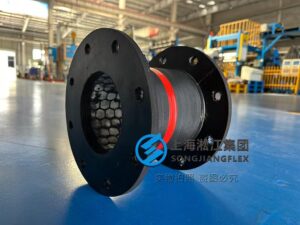
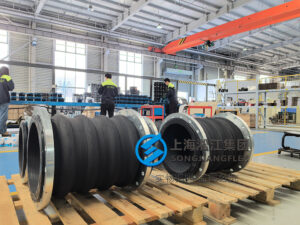
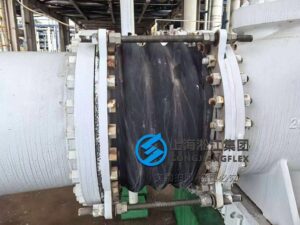
Based on these requirements, we designed a custom PTFE lined EPDM rubber expansion joint capable of operating reliably in a harsh offshore environment.
The final solution provided excellent vibration isolation, corrosion resistance, and installation flexibility for the offshore pipeline system.
Conclusion
Offshore drilling platforms require pipeline components that can perform reliably in challenging conditions.
PTFE lined rubber expansion joints provide the ideal combination of corrosion resistance, flexibility, and high pressure capability. When combined with features such as floating flange designs, they can also solve installation challenges like pipe misalignment.
For offshore oil and gas projects, these expansion joints play a critical role in improving pipeline safety, durability, and long-term system reliability.