Why is this rubber expansion joint suitable for complex pipeline conditions?
Complex pipeline systems often fail due to vacuum stress and thrust forces. Standard expansion joints cannot withstand these conditions, leading to deformation and system failure risks.
This rubber expansion joint is engineered with reinforced vacuum resistance and an integrated tie-rod system to handle blind flange thrust forces. It ensures stability under negative pressure, axial loads, and real installation stresses, making it suitable for complex pipeline environments in industrial applications where both vacuum conditions and mechanical forces coexist.
Below are the key engineering principles that ensure its reliable performance.
Vacuum & negative pressure resistance design
Pipeline systems operating under vacuum or negative pressure conditions place extreme structural demands on rubber expansion joints.
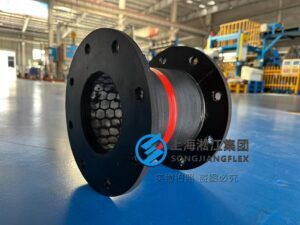
Customer pipeline systems often operate under negative pressure and vacuum conditions, which can easily cause structural collapse or deformation in conventional expansion joints. To solve this, we integrate a reinforced vacuum support design that increases ring stiffness and anti-collapse capability, ensuring stable performance even under continuous or fluctuating vacuum environments.
In real industrial systems such as pumping stations, drainage pipelines, and vacuum transport lines, pressure fluctuations are frequent and unpredictable. Without reinforcement, the rubber body may collapse inward due to external atmospheric pressure. Our design distributes this external force evenly across the structure, maintaining geometric stability and preventing fatigue damage over long-term operation. This significantly improves safety and service reliability in critical pipeline systems.
How tie-rod system handles blind flange thrust force
Blind flange thrust force is one of the most critical mechanical challenges in high-pressure pipeline systems.
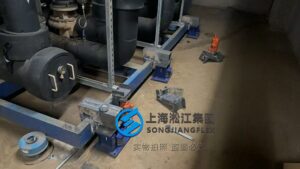
Due to significant blind flange thrust forces in real installations, our engineering team adopts an integrated tie-rod restraint structure. This system effectively absorbs and redistributes axial loads generated by internal pressure surges, pump start-stop operations, and flow direction changes, preventing over-extension and structural overload of the rubber body.
In practical engineering environments, axial thrust is constantly generated during system operation, especially in pump outlets and compressor pipelines. These forces can cause flange separation or excessive elongation if not properly controlled. The tie-rod system transfers mechanical stress to the pipeline structure itself, protecting the rubber element and ensuring controlled movement within safe design limits, greatly improving operational safety and service life.
Structural stability in real pipeline installation
Real pipeline installations are rarely perfect and often involve misalignment, vibration, and thermal expansion.
The expansion joint is designed to accommodate axial, lateral, and angular movements while maintaining structural integrity. Its reinforced body ensures stable performance even under misalignment and vibration, reducing stress concentration at flange connections and improving long-term durability in complex industrial systems.
In actual field conditions, pipeline systems are affected by equipment vibration, installation deviation, and thermal expansion cycles. These factors continuously stress the connection points. By allowing controlled multi-directional movement, the expansion joint reduces mechanical fatigue and protects critical equipment such as pumps, compressors, and heat exchangers, ensuring long-term operational reliability across industrial applications.
Why engineering customization matters?
Standard expansion joints often fail to meet the requirements of complex and highly variable industrial pipeline systems.
Engineering customization ensures that each expansion joint is designed based on real operating conditions such as pressure, vacuum level, temperature, and thrust load. This product is optimized specifically for complex pipeline environments, delivering reliable performance instead of a one-size-fits-all solution.
Different industries such as oil & gas, power generation, metallurgy, and water treatment require tailored engineering solutions. Buyers like Murtaza in the Middle East often face urgent project timelines and demanding operating conditions. Customized design allows Songjiangflex to provide precise solutions that match real-world stress conditions, improving project efficiency and reducing long-term maintenance risks.
Summary
This rubber expansion joint is engineered for vacuum resistance, axial thrust absorption, and real-world pipeline complexity, delivering long-term reliability in industrial applications.