Why Do Thermal Oil Pipelines Keep Vibrating, and How Can SAE Rubber Compensators Solve High-Temperature Vibration Problems?
Thermal oil pipelines often suffer continuous vibration, causing leaks, fatigue, and equipment damage. SAE rubber compensators provide an effective high-temperature vibration isolation solution.
Thermal oil pipeline vibration is mainly caused by pump pulsation, thermal expansion stress, and fluid turbulence. An SAE rubber compensator uses high-temperature, oil-resistant rubber and flexible construction to absorb vibration, reduce noise, and compensate pipeline movement, making it ideal for high-temperature hot oil systems.
Understanding vibration sources explains why proper compensators are essential.
What Causes Vibration in Thermal Oil Pipeline Systems?
Thermal oil pipeline vibration originates from multiple mechanical and hydraulic factors inside heat transfer oil systems.
Common causes include pump pulsation, fluid turbulence, mechanical misalignment, and thermal fluid circulation vibration, especially in industrial hot oil piping and high temperature pipelines.
In heat transfer oil systems, centrifugal pumps generate periodic pressure fluctuations that create thermal oil pipeline vibration. Long straight piping amplifies resonance, while elbows and reducers create turbulence. When rigid pipelines are directly connected to pumps, vibration in high temperature pipelines easily spreads throughout the system. Over time, industrial hot oil piping vibration becomes a persistent issue that damages joints, flanges, and connected equipment.
How Does High Temperature Accelerate Mechanical Fatigue in Pipelines?
High operating temperatures significantly accelerate fatigue and structural degradation in thermal oil pipelines.
High temperature pipeline fatigue is driven by thermal expansion stress piping, repeated temperature cycling, and heat induced vibration damage.
Hot oil systems constantly expand and contract during startup and shutdown. This pipeline thermal stress produces microscopic cracks in metal components. Combined with vibration, hot oil system fatigue failure develops much faster. As temperature rises, material strength decreases, making pipelines more sensitive to dynamic loads and accelerating mechanical fatigue.
Why Are Metal Expansion Joints Often Unsuitable for Thermal Oil Vibration Isolation?
Metal expansion joints are designed for movement, but not ideal for vibration isolation.
Metal expansion joint limitations include poor damping, stainless steel expansion joint vibration transmission, and metal bellows fatigue failure.
Metal bellows mainly accommodate axial movement but offer minimal vibration absorption. High temperature metal compensator problems often include cracking at convolution roots and expansion joint cracking under cyclic loads. Stainless steel expansion joint vibration easily transfers noise and stress to connected equipment, making metal joints less suitable for hot oil vibration isolation.
What Is an SAE Rubber Compensator and How Does It Work?
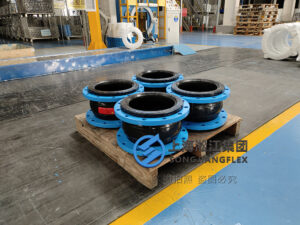
An SAE rubber compensator is a flexible rubber expansion joint specifically designed for fluid piping systems.
A high temperature rubber compensator uses multilayer oil-resistant rubber and reinforcement to function as a rubber flexible joint for hot oil pipeline systems.
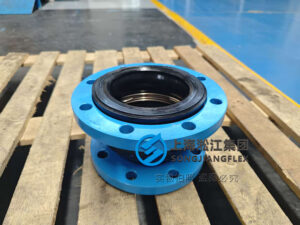
The SAE rubber compensator consists of an inner oil-resistant rubber layer, reinforced fabric or steel cord layers, and an outer protective rubber layer. As an SAE standard rubber expansion joint, it connects easily with pumps and pipelines. When vibration occurs, the rubber body deforms elastically, dissipating energy and isolating motion.
How Can SAE Rubber Compensators Absorb Vibration, Noise, and Thermal Expansion Simultaneously?
SAE rubber compensators provide multi-functional pipeline protection in one component.
They act as vibration absorption rubber joints, noise reduction rubber expansion joints, and thermal expansion rubber compensators simultaneously.
High-damping rubber converts vibration energy into heat, providing flexible rubber joint vibration isolation. The elastic structure also allows axial, lateral, and angular movement for pipeline movement compensation. Additionally, rubber’s acoustic insulation properties reduce structure-borne noise transmission through piping systems.
Which Rubber Materials Are Suitable for High-Temperature Thermal Oil Systems?
Material selection determines the service life of rubber expansion joints in hot oil applications.
High temperature rubber materials include NBR rubber thermal oil resistant grades, HNBR rubber expansion joints, and FKM rubber compensators.
NBR offers good oil resistance for moderate temperatures. HNBR provides improved heat and aging resistance. FKM (Viton) offers superior performance for higher temperatures and aggressive oils. Selecting the correct oil resistant rubber expansion joint ensures long-term sealing and vibration isolation.
How Do SAE Rubber Compensators Extend Pipeline and Pump Service Life?
Effective vibration isolation directly protects rotating equipment and piping.
SAE rubber compensators help extend pump life, protect piping systems, and reduce mechanical wear.
By isolating vibration, bearing loads on pumps decrease. Flange connections experience less stress, reducing leakage risk. This vibration induced failure prevention approach forms a complete pipeline protection solution, lowering maintenance frequency and downtime.
What Installation Positions Maximize the Performance of Rubber Compensators in Thermal Oil Lines?
Correct installation location is essential for optimal performance.
Typical rubber compensator installation positions include pump inlets, pump outlets, and key pipeline flexible joint locations.
Installing a pump inlet rubber joint isolates vibration at its source. Additional units near heat exchangers or long straight pipe sections improve hot oil system layout flexibility. Proper vibration isolation design ensures compensators are not overstressed.
How to Select the Right SAE Rubber Compensator for High-Temperature Applications?
Correct selection ensures safety and reliability.
Consider rubber expansion joint sizing, pressure temperature rating rubber joint, and thermal oil rubber joint selection guide principles.
Engineers should define operating temperature, pressure, medium, diameter, and movement requirements. When standard products cannot meet conditions, a custom rubber compensator is recommended for optimal performance.
Why Choose a Professional SAE Rubber Compensator Manufacturer?
Manufacturer capability directly affects product reliability.
A professional rubber compensator manufacturer ensures quality materials, testing, and customization.
An experienced SAE rubber expansion joint factory or custom rubber expansion joint supplier performs pressure testing, fatigue testing, and material verification. Working with an industrial rubber joint manufacturer or China rubber compensator supplier provides stable quality, technical support, and cost advantages.
SAE rubber compensators provide reliable vibration isolation, noise reduction, and thermal expansion control for high-temperature thermal oil pipeline systems.