Why Are Wear-Resistant Wrapped Rubber Expansion Joints Essential for Pulp Pipelines?
Pulp pipelines suffer constant abrasion, leakage, and premature joint failure, causing costly downtime and urgent maintenance that disrupts production schedules. Choosing a reliable wear-resistant rubber expansion joint is critical for long-term operational stability.
Wear-resistant wrapped rubber expansion joints are essential for pulp pipelines because they withstand fiber abrasion, absorb movement, and extend service life. Their reinforced wrapped structure reduces wear, prevents leakage, and minimizes maintenance frequency in demanding paper mill environments.
To understand their value, it is important to examine pulp flow characteristics, structure design, and material selection.
Why do pulp pipelines cause severe wear to expansion joints?
Pulp pipelines transport a mixture of water, fibers, and solid particles, creating continuous friction and impact on internal pipeline components.
The combination of high flow velocity, suspended fibers, and abrasive particles causes intense internal wear. Standard rubber expansion joints often fail prematurely under such conditions, leading to leakage and frequent replacement.
In paper mills, pulp media behaves very differently from clean water. Fibers constantly scrape the inner surface of pipelines and expansion joints, while pressure fluctuations increase mechanical stress. When ordinary rubber joints are used, internal rubber layers thin quickly, reinforcement becomes exposed, and failure occurs. This makes abrasion resistance a critical design requirement rather than an optional feature.
What is a wear-resistant wrapped rubber expansion joint?
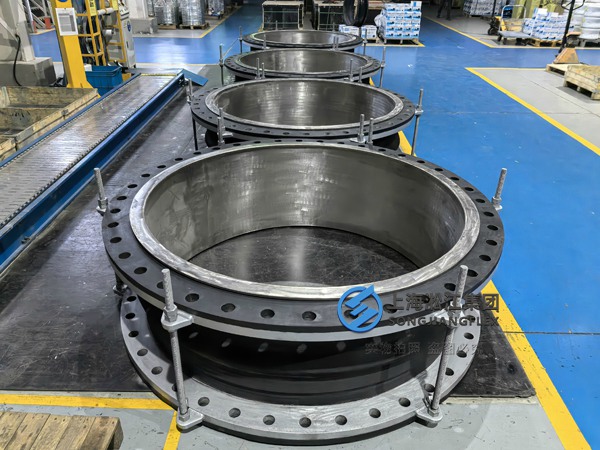
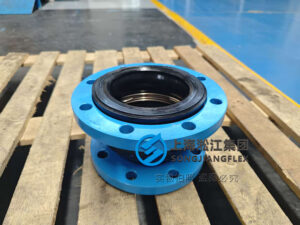
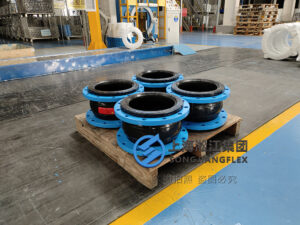
A wear-resistant wrapped rubber expansion joint is a flexible connector manufactured using a layered wrapping process instead of traditional molding.
Its wrapped construction allows thicker inner rubber layers and stronger reinforcement, significantly improving abrasion resistance and structural durability in pulp pipeline applications.
Unlike molded joints with uniform thickness, wrapped rubber expansion joints are built layer by layer. This enables precise control of inner liner thickness, fiber reinforcement orientation, and overall strength. For large-diameter pulp pipelines, this structure offers better flexibility, pressure resistance, and long-term reliability, especially in continuous-operation paper mills.
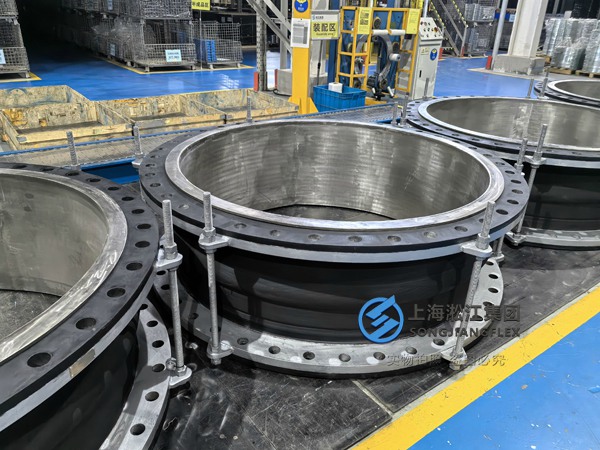
How does the wrapped structure improve abrasion resistance in pulp pipelines?
The wrapped structure enhances abrasion resistance by distributing mechanical stress more evenly across multiple reinforced rubber layers.
By increasing liner thickness and reinforcement density, wrapped joints resist fiber scouring and slow down internal wear, extending service life.
In pulp flow conditions, abrasion concentrates on bends, joints, and flexible connections. Wrapped construction creates a multi-layer barrier that absorbs impact energy and reduces localized wear. As part of a complete pulp pipeline vibration solution, this design helps prevent sudden failure and unplanned shutdowns.
What materials are best for rubber expansion joints used in pulp pipelines?
Material selection plays a decisive role in determining the wear resistance and lifespan of rubber expansion joints in pulp systems.
Natural rubber and specially formulated abrasion-resistant compounds are commonly used to balance durability, flexibility, and cost-effectiveness.
For pulp pipelines, high-abrasion natural rubber or blended compounds are often preferred due to their excellent wear resistance and elasticity. Compared to standard elastomers, these materials better withstand continuous fiber contact and pressure variation. For cost-sensitive buyers in markets like the Middle East, optimized formulations offer a practical balance between performance and budget.
How do wear-resistant rubber expansion joints reduce downtime and maintenance costs?
Reducing downtime is a key priority for paper mills operating under tight production schedules and frequent urgent orders.
Longer service life and fewer failures mean less maintenance, fewer emergency shutdowns, and lower total operating costs.
When expansion joints last longer, maintenance intervals are extended, spare parts inventory is reduced, and production planning becomes more predictable. For buyers who frequently face urgent delivery demands, working with a reliable custom rubber expansion joint manufacturer helps secure long-term supply stability and operational efficiency.
Summary
Wear-resistant wrapped rubber expansion joints provide the durability, flexibility, and reliability required for pulp pipelines, making them a smart long-term solution for paper mill operations.