Why Are Vacuum Ring Rubber Expansion Joints Essential for Negative Pressure Pipeline Systems in Chemical, Pharmaceutical, and Food Industries?
Negative pressure pipelines often suffer from collapse risk, vibration, and noise, which can seriously threaten system stability. Without proper flexible connections, these issues escalate into leaks, equipment damage, and unplanned shutdowns.
A vacuum ring rubber expansion joint is a specialized solution for negative pressure pipeline systems, designed to resist collapse, absorb vibration, reduce noise, and protect equipment in chemical vacuum conveying, pharmaceutical purification, and food vacuum processing applications.
To understand why these components are indispensable, it is necessary to examine how vacuum pipelines behave and what engineering challenges they face.
Vacuum pipelines operate under negative pressure conditions that impose inward forces on pipe walls, joints, and connections. Unlike positive pressure systems, where internal pressure supports the pipe structure, vacuum systems continuously pull inward, increasing the risk of deformation, vibration transmission, and joint failure.
In chemical, pharmaceutical, and food processing plants, negative pressure pipelines are often connected to vacuum pumps, blowers, and separators. These machines generate continuous vibration and pressure fluctuations, which rigid connections cannot absorb. Without flexible compensation, vibration is transmitted directly to flanges and equipment, accelerating fatigue and increasing maintenance costs.
What problems do negative pressure pipelines commonly face?
Negative pressure pipelines are exposed to a unique set of operational challenges that differ significantly from those found in positive pressure systems. Under vacuum conditions, the internal pressure continuously pulls inward on pipe walls, joints, and flexible connections. This inward force increases the risk of pipeline deformation, joint collapse, excessive vibration, and noise transmission. If these issues are not properly addressed, they can escalate into flange leakage, equipment misalignment, accelerated fatigue, and unplanned shutdowns, all of which severely affect system reliability and production efficiency.
Why are vacuum pipeline systems more vulnerable than positive pressure systems?
Positive pressure pipelines benefit from internal pressure that naturally supports the pipe structure and stabilizes joints. Vacuum pipelines operate in the opposite manner. Negative pressure applies continuous compressive stress to the internal surfaces of the pipeline, making them more susceptible to inward deformation and structural instability. Even small design weaknesses can be magnified under vacuum, particularly at flexible connections and flanged joints, making vacuum systems far less tolerant of rigid or improperly designed components.
What is a vacuum ring rubber expansion joint?
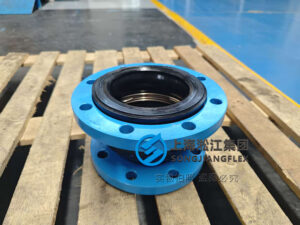
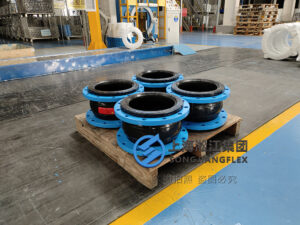
A vacuum ring rubber expansion joint is a flexible pipeline connector specifically engineered for negative pressure applications. It combines a multi-layer reinforced rubber body with an internal vacuum ring that provides structural support against inward collapse. This configuration allows the joint to accommodate axial, lateral, and angular movement while maintaining dimensional stability and sealing performance under continuous vacuum conditions. As a result, it functions reliably as a rubber expansion joint for vacuum pipelines where standard joints would fail.
How does a vacuum ring prevent collapse under negative pressure?
When a vacuum is applied, the pressure differential forces the rubber body inward, which can cause buckling or collapse in conventional rubber joints. The vacuum ring acts as an internal reinforcement, resisting these inward forces and maintaining the joint’s internal diameter. By stabilizing the rubber body, the vacuum ring ensures that vibration isolation and movement compensation can occur without compromising structural integrity, even during prolonged vacuum operation.
Why are standard rubber expansion joints unsuitable for vacuum systems?
Standard rubber expansion joints are primarily designed for positive pressure systems, where internal pressure helps support the rubber structure. Under negative pressure, these joints are subjected to stresses they were not engineered to withstand. Over time, this can lead to inward collapse, loss of sealing capability, internal delamination, or permanent deformation. As a result, their use in vacuum pipelines significantly increases the likelihood of leakage, premature failure, and system downtime.
What distinguishes vacuum ring rubber expansion joints from non-vacuum designs?
The fundamental difference lies in how the joint resists pressure. Vacuum ring rubber expansion joints are designed to withstand inward pressure forces, while non-vacuum joints are optimized only for outward pressure. By integrating internal structural reinforcement with elastic rubber materials, vacuum ring designs achieve a balance between flexibility and strength. This makes them far more reliable in negative pressure environments and extends their service life compared to non-vacuum alternatives.
How do vacuum ring rubber expansion joints control vibration and noise?
Vacuum systems are commonly connected to pumps, blowers, and separators that generate continuous vibration and pressure fluctuations. A vacuum ring rubber expansion joint absorbs these vibrations at the connection point, preventing them from being transmitted into pipelines and connected equipment. This reduces noise levels, minimizes mechanical stress on flanges and machinery, and helps prevent fatigue-related failures, contributing to smoother and quieter system operation.
Where are vacuum ring rubber expansion joints most commonly used?
These expansion joints are widely applied in chemical vacuum conveying systems, pharmaceutical negative pressure purification lines, and food vacuum processing equipment. In such environments, stable vacuum conditions are essential for process control, product quality, and hygiene compliance. Vacuum ring rubber expansion joints provide the necessary flexibility and anti-collapse protection to ensure uninterrupted operation in these demanding applications.
Can vacuum ring rubber expansion joints handle pressure fluctuations?
Many industrial systems experience pressure changes during startup, shutdown, or process transitions. Properly engineered vacuum ring rubber expansion joints are capable of withstanding both continuous negative pressure and limited positive pressure. This dual capability allows the joint to maintain stability under vacuum while safely accommodating temporary pressure reversals, making it suitable for complex and dynamic operating conditions.
What materials are used for vacuum rings in rubber expansion joints?
Vacuum rings are typically manufactured from carbon steel or stainless steel, depending on application requirements. Carbon steel vacuum rings are commonly used in general industrial vacuum systems where corrosion resistance demands are moderate. Stainless steel vacuum rings are preferred in corrosive environments or hygienic applications, such as pharmaceutical and food processing, where cleanliness and long-term durability are critical.
How should a vacuum ring rubber expansion joint be selected?
Selecting the correct vacuum ring rubber expansion joint requires careful evaluation of vacuum level, pipe diameter, operating temperature, conveyed media, and flange standards. Additional factors such as chemical compatibility and system vibration levels must also be considered. Working with an experienced manufacturer ensures the joint is properly designed and customized to meet specific system requirements, maximizing safety and service life.
What risks arise if vacuum ring expansion joints are not installed?
Without vacuum ring expansion joints, negative pressure pipeline systems face significantly higher risks of collapse, leakage, vacuum loss, and equipment damage. These failures can lead to costly downtime, increased maintenance expenses, and potential safety hazards. In continuous-operation environments, even short interruptions can result in substantial production losses.
Why are vacuum ring rubber expansion joints essential in negative pressure systems?
Vacuum ring rubber expansion joints play a critical role in ensuring the safety, stability, and reliability of negative pressure pipeline systems. By preventing inward collapse, isolating vibration, reducing noise, and accommodating movement, they protect both pipelines and connected equipment. In chemical, pharmaceutical, and food industries where vacuum pipelines are integral, these components are indispensable for long-term, trouble-free operation.