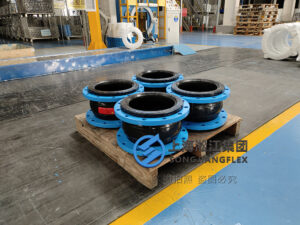
What Is a WCR-L Anti-Settlement Winding Rubber Expansion Joint and How Does It Protect Pipelines from Damage?
Pipeline settlement often causes excessive displacement, risking cracks or failure. Traditional joints fail under stress. The WCR-L anti-settlement rubber expansion joint provides reliable protection for pipelines.
The WCR-L anti-settlement winding rubber expansion joint absorbs large pipeline displacements caused by ground settlement. Using German winding technology, it distributes stress evenly, enhances structural stability, and ensures long-term pipeline integrity in municipal and industrial systems.
Discover how this anti-settlement expansion joint works, its structure, advantages, and industrial applications.
How Does Ground Settlement Cause Large Displacement and Pipeline Failure?
Ground settlement in pipelines creates axial, lateral, and angular displacement, posing risks for industrial and municipal piping systems.
Uneven foundation movement exceeds the tolerance of standard flexible joints. Pipeline stress concentrates at weak points, resulting in rubber tearing, flange deformation, and potential system failure.
Settlement occurs due to soil consolidation, excavation, or groundwater changes. Rigid pipelines and ordinary rubber joints cannot compensate for accumulated displacement. This leads to fatigue, leaks, or sudden ruptures. Using anti-settlement winding rubber joints mitigates these risks, protecting pumps, valves, and connected equipment in large-scale industrial and municipal pipeline systems.
Semantic Keywords Embedded: ground settlement, pipeline displacement, anti-settlement winding rubber joint, industrial pipeline protection
What Is the Structural Design of the WCR-L Winding Rubber Expansion Joint?
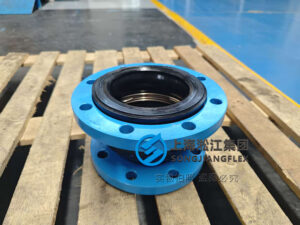
The WCR-L winding rubber joint features a multi-layered structure designed to handle axial, lateral, and angular displacement efficiently.
High-strength cord reinforcements are wound in controlled angles, allowing uniform stress distribution. This design enhances pressure resistance while preventing localized failure under large displacement.
Unlike molded rubber joints, the winding design spreads mechanical stress across layers, improving fatigue resistance. Each layer flexes under load, absorbing pipeline movement. This flexible pipe joint is ideal for high-displacement scenarios, such as municipal water supply networks, pump stations, and industrial pipelines.
Semantic Keywords Embedded: WCR-L winding rubber joint, flexible pipe joint, pipeline displacement compensation, high-displacement pipeline
Why Does the German Winding Manufacturing Process Improve Safety and Stability?
Precision in manufacturing is critical for rubber expansion joints subjected to large, unpredictable pipeline displacement.
The German winding technology aligns reinforcement layers with operational stresses, optimizing load distribution. It significantly improves safety, stability, and lifespan compared to conventional processes.
Traditional manufacturing may misalign reinforcement cords, causing stress concentration and premature failure. German winding techniques ensure cord orientation matches expected displacement patterns. This method enhances deformation control, prevents delamination, and maintains consistent performance under repeated settlement, making it ideal for industrial and municipal pipeline protection.
Semantic Keywords Embedded: German winding technology, anti-settlement expansion joint, pipeline stress absorption, WCR-L rubber expansion joint
How Does the WCR-L Expansion Joint Prevent Pipeline Damage During Settlement?
The WCR-L anti-settlement rubber expansion joint absorbs axial, lateral, and angular movements, preventing pipeline damage and maintaining operational stability.
By compensating for large displacements, the joint reduces stress on connected pipelines, avoiding cracking, flange pull-out, and rubber rupture. It ensures long-term integrity of high-pressure pipelines.
During settlement, pipelines shift with foundation movement. The WCR-L joint acts as a flexible buffer, converting sudden displacement into gradual deformation. It protects pumps, valves, welds, and other connected equipment. This large displacement pipeline solution is particularly effective in municipal water supply, industrial plants, and areas prone to ground settlement.
Semantic Keywords Embedded: large displacement pipeline solution, vibration and stress absorption, high-pressure rubber expansion joint, WCR-L anti-settlement rubber expansion joint
Where Are WCR-L Anti-Settlement Rubber Expansion Joints Commonly Used?
These joints are ideal for pipelines exposed to soil movement, heavy equipment vibrations, or settlement-prone environments.
Applications include municipal water networks, underground utility corridors, pump stations, industrial plants, and high-rise water supply systems. They enhance system safety and reduce maintenance needs.
In secondary water supply systems, buried pipelines, and heavy industrial networks, settlement is inevitable. WCR-L winding rubber joints provide long-term stability, vibration absorption, and protection against pipeline rupture. Their flexibility ensures reliable operation even under high pressure and repeated displacement cycles.
Semantic Keywords Embedded: anti-settlement expansion joint, industrial pipeline protection, flexible pipe joint, WCR-L winding rubber joint
What Should Buyers Consider When Selecting a Winding Rubber Expansion Joint?
Selecting the right joint requires evaluating displacement capacity, manufacturing process, quality control, and supplier reliability.
Buyers should check German winding technology, testing standards, delivery capability, and customization options. Proper selection reduces operational risk and ensures system longevity.
For distributors and engineers, especially in urgent projects, supplier reliability is critical. Factories with automated production lines, rigorous testing (pressure, fatigue, displacement), and engineering support provide consistent quality. Choosing the anti-settlement winding rubber joint ensures high performance, safety, and long-term cost efficiency.
Semantic Keywords Embedded: anti-settlement winding rubber joint, WCR-L rubber expansion joint, pipeline displacement compensation, high-pressure rubber expansion joint
Summary
The WCR-L anti-settlement winding rubber expansion joint delivers reliable protection for pipelines, combining German winding technology with superior displacement absorption and long-term operational stability.